Cheapest Semiconductor ETF, Chip ETFs Ranked by Expense Ratio
CHPS is the cheapest semiconductor ETF at 0.15%, then SOXQ 0.19%, SOXX 0.33% and SMH 0.35%. What each fee buys, and when owning the chip stocks costs less.
September 2026 · Indexes
The backtest did not run just now. Tap Backtest it to try again.
Educational only · Never places a trade
The cheapest semiconductor ETF is the Xtrackers Semiconductor Select Equity ETF (CHPS) at 0.15% a year, followed by the Invesco PHLX Semiconductor ETF (SOXQ) at 0.19%. The two biggest chip funds cost about twice as much: iShares SOXX charges 0.33% after a recent cut from 0.34%, and VanEck SMH 0.35%. At the top of the range, Invesco PSI charges 0.55% and First Trust FTXL 0.60%. Cheapest of all is owning the chip stocks directly, where there is no expense ratio.
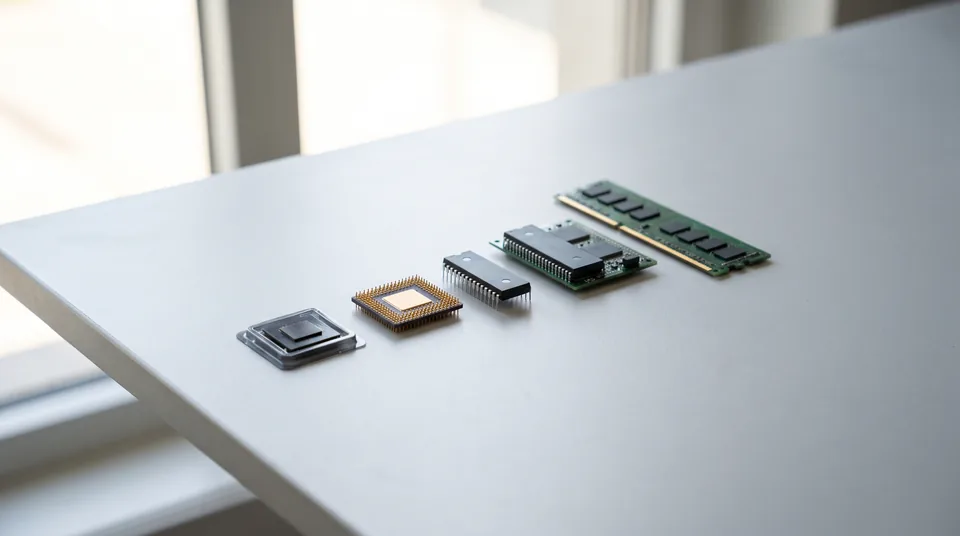
The fee gap between these funds is small in percentage terms. The gap in what they hold is not. One puts almost a fifth of your money into NVIDIA, another caps every stock at 4.5%, and a third weights 47 companies roughly equally. So the cheapest fund is only the right fund if its weighting matches what you meant to buy. Below, every major US-listed semiconductor ETF is ranked by expense ratio, with the dollar cost and the weighting rule next to it.
Expense ratios, holdings counts, assets and top positions come from each issuer's fund page, holdings file, fact sheet or prospectus, read on September 28, 2026. We make index construction and backtesting software; we do not sell funds or give investment advice.
Cheapest semiconductor ETFs ranked by expense ratio
| Rank | ETF | Expense ratio | Cost on $10,000 | Cost on $50,000 | Holdings | Weighting |
|---|---|---|---|---|---|---|
| 1 | Xtrackers Semiconductor Select Equity (CHPS) | 0.15% | $15 | $75 | 54 | Market cap, 4.5% cap, global |
| 2 | Invesco PHLX Semiconductor (SOXQ) | 0.19% | $19 | $95 | 30 | SOX index: top three capped at 12%, 10%, 8% |
| 3 | iShares Semiconductor (SOXX) | 0.33% | $33 | $165 | 30 | 8% cap, 4% outside the top five |
| 4 (tie) | VanEck Semiconductor (SMH) | 0.35% | $35 | $175 | 25 | Largest names up to 20% each |
| 4 (tie) | SPDR S&P Semiconductor (XSD) | 0.35% | $35 | $175 | 47 | Modified equal weight |
| 4 (tie) | VanEck Fabless Semiconductor (SMHX) | 0.35% | $35 | $175 | 22 | Chip designers only, SMH caps |
| 7 | Invesco Semiconductors (PSI) | 0.55% | $55 | $275 | 31 | Quant screen, reset quarterly |
| 8 | First Trust Nasdaq Semiconductor (FTXL) | 0.60% | $60 | $300 | 37 | Weighted by cash flow, 8% cap |
And the specialty funds that show up in the same searches:
| ETF | Expense ratio | What it is |
|---|---|---|
| Roundhill Memory (DRAM) | 0.65% | Actively managed memory fund launched in April 2026. Micron, Samsung and SK hynix were about 74% of it on September 28. |
| Direxion Daily Semiconductor Bull 3X (SOXL) | 0.75% net, 0.91% gross | Three times the daily move of the NYSE Semiconductor Index. The fee waiver runs to September 1, 2027. A trading tool, not a holding. |
| Tuttle Capital Concentrated Memory Stack (HBMX) | 0.95% | Actively managed memory fund launched in June 2026, per its prospectus. |
What is the cheapest semiconductor ETF?
CHPS, at 0.15%. It tracks the Solactive Semiconductor Focus Index: the 50 largest chip companies worldwide by free-float market cap, each capped at 4.5%. On September 25 it held 54 securities, led by AMD, Micron, Intel, NVIDIA and TSMC's Taipei-listed shares, all between 4.5% and 5.5%. Two things to know before buying it. It is small, about $125 million in assets against $74.6 billion in SMH, so check the bid-ask spread before placing a large order. And it is global, so part of your money sits in shares listed in Taiwan, Korea, Japan and the Netherlands rather than in US-listed ADRs. The index dropped its ESG screen on July 7, 2026, which is why older articles call it an ESG fund.
SOXQ, at 0.19%, is the cheapest way to own the PHLX Semiconductor Sector Index, the SOX, which most people mean when they say "the semiconductor index". It holds 30 US-listed chip companies, ADRs included. Nasdaq's methodology caps the three largest at 12%, 10% and 8% and everyone else at 4%, so on September 25 NVIDIA was 11.2% of the fund, Broadcom 8.7% and Micron 8.2%.
Is SOXQ the same as SOXX?
No, although both hold 30 stocks and their names sound alike. SOXQ tracks Nasdaq's PHLX Semiconductor Sector Index for 0.19%. SOXX tracks ICE's NYSE Semiconductor Index for 0.33%, with a different cap scheme: every stock at most 8%, stocks outside the five largest at most 4%, and all ADRs together at most 10%. That ADR limit matters because TSMC and ASML are two of the largest chip companies in the world and both trade in the US as ADRs. SOXX is the far bigger fund, about $48 billion against $3.3 billion, which usually means tighter trading spreads. If you hold for years, the 0.14% fee difference is the bigger number.
Is SMH worth the higher fee?
SMH costs 0.35%, only 0.16% more than SOXQ, but it is a different bet rather than a pricier version of the same one. Its index, the MVIS US Listed Semiconductor 25, lets the largest chip companies hold between 5% and 20% each, with the group of them limited to 50% in total. On September 25 that put 19.1% in NVIDIA, 9.2% in TSMC and more than 44% in the top five. If you believe the leaders keep winning, SMH gives you more of them than any other plain chip fund. If you already own an S&P 500 or Nasdaq-100 fund, you already hold a lot of NVIDIA and Broadcom, and SMH doubles down on exactly those names.
VanEck's newer SMHX uses the same caps on chip designers only, companies that design chips and pay a foundry to make them, so TSMC, Intel and the equipment makers are out. Same 0.35% fee, 22 stocks, NVIDIA 18.5% and Broadcom 11.6%.
Which semiconductor ETF is not dominated by NVIDIA?
XSD. It follows the S&P Semiconductor Select Industry Index, which is modified equal weight, so each of its 47 stocks starts near 2%. On September 25 its largest holdings were MaxLinear, Credo, Astera Labs, AMD and Rambus, each under 3%. That makes XSD mostly a small and mid-cap chip fund, and it behaves very differently from SMH in years when the giants lead. CHPS is the other option, with a 4.5% ceiling per stock at less than half XSD's fee.
How much do semiconductor ETF fees cost over 10 years?
More than the yearly figure suggests, because the fee comes out every year and compounds. Take $25,000 growing 8% a year before fees. After ten years at CHPS's 0.15% you would have about $53,170. At SMH's 0.35%, about $52,110. At FTXL's 0.60%, about $50,820. The difference between the cheapest and the priciest plain chip fund is about $2,350 on a $25,000 starting balance, before any difference in what the funds hold. These are illustrations of fee drag, not forecasts of returns.
Does Vanguard have a semiconductor ETF?
No. Vanguard does not run a fund dedicated to semiconductors. The Vanguard Information Technology ETF (VGT) is the fund people reach for at 0.09%, and it holds NVIDIA, Broadcom and Micron, but they sit among 321 technology stocks alongside Apple and Microsoft. It is a cheap tech sector fund with chips inside it, not a semiconductor index. Our cheapest AI ETF ranking compares it with the AI funds in the same way.
Is a leveraged semiconductor ETF like SOXL cheaper to hold?
No, and the headline fee is the smaller cost. SOXL's net expense ratio is 0.75%, after a waiver that brings it down from 0.91% until September 2027. On top of that, its holdings file on September 28 showed about three times the index's exposure built from the stocks plus swap contracts, and the fund resets that leverage every day. Over months, daily resetting makes the result drift away from three times the index's return, especially when chip stocks swing hard in both directions, which they do. It is built for traders holding for days, not for owning the industry.
The cheapest alternative is building the semiconductor index yourself
Owning the chip stocks directly has no expense ratio. At a broker with fractional shares you can buy 20 or 30 chip names at exact weights with a few hundred dollars. Fidelity Basket Portfolios is built for it: up to 50 stocks or ETFs in one order, from $1 per position, for a flat $4.99 a month. That is $59.88 a year however large the basket gets. Against a 0.35% fund the flat fee is cheaper once the basket passes about $17,100. Against SOXQ's 0.19% the break-even is about $31,500, and against CHPS about $39,900. Below those balances the ETF is cheaper and needs no upkeep.
The stronger reason to build is that you set the cap. Every fund above is a set of choices about how much NVIDIA to hold, whether equipment makers like ASML and Applied Materials count, and whether memory belongs at all. In a semiconductor index builder you make those choices yourself, weight the basket by layer if you like (designers, foundries, equipment, memory, analog), and backtest it against the Nasdaq-100 or a one-line SMH index before any money moves. Before giving a smaller name like Credo or Astera Labs a slot, you can stress-test a single chipmaker thesis against 20 years of price data rather than adding it because it showed up in a fund's top ten.
Then there is tax. Each stock in a basket has its own cost basis, so when one chipmaker drops 30% while the rest of the basket is up, you can sell that one position for a loss and hold a similar company in its place. Inside an ETF that loss never reaches you. The wash sale calculator shows what happens if you buy the same stock back within 30 days.
Which cheap semiconductor ETF should you pick?
- Lowest cost for the classic 30-stock US index: SOXQ at 0.19%.
- Lowest cost overall, global, no stock above 4.5%: CHPS at 0.15%, if the smaller fund size does not bother you.
- Most weight in the leaders: SMH at 0.35%, about 19% NVIDIA.
- Small and mid-size chip companies: XSD at 0.35%, equal weighted.
- Your own caps, no expense ratio, per-stock tax losses: build the basket and hold it at a broker. The semiconductor index builder page puts all ten funds' index rules and top holdings side by side, and the equal weight index builder shows what XSD-style weighting does to any basket.
Whichever you choose, read the holdings before the fee. Two chip funds 0.04% apart in cost can hold completely different slices of the industry, and the difference in what you own will move your returns far more than the difference in what you pay.
Build your index and see how it backtests
Bundle stocks or crypto into your own weighted index, backtest it against real market history, and track it against the S&P 500 or BTC. Educational and informational only, and Indexes never places a trade.