AI infrastructure stocks index builder to compare every AI infrastructure ETF and build your own from AI data center stocks.
One AI infrastructure fund is 80% power and grid companies. Another is mostly cell towers. Pick the layers you actually believe in, weight them yourself, and see how the basket would have done next to the S&P 500 and the funds. Then buy it at your own broker.
The backtest did not run just now. Tap Backtest it to try again.
Educational only · Never places a trade
In short
AI infrastructure stocks are the companies that build the physical side of AI: chips and servers, networking, electrical equipment and cooling, power producers, contractors and data center owners. The ETFs sold under that label split them very differently. Defiance's AIPO (0.69%) puts 80% of its index into power, grid equipment, utilities and construction by rule. Global X's DTCR (0.50%) is about 60% real estate, and a quarter of it is cell tower REITs. VanEck's RACK (0.50%) holds only about 3% in data center REITs. Building your own AI infrastructure index means choosing the layer weights yourself, backtesting the basket and buying the stocks at a broker, where there is no expense ratio.
Same label, four different funds
What is actually inside an AI infrastructure ETF?
Each bar is one fund, split the way its issuer publishes it: the index's own sleeve rules for AIPO, the issuer's sector breakdown for DTCR and ZAP, and the holdings file for RACK.
AIPO
Index sleeves
DTCR
Issuer sector split, Aug 31
ZAP
Issuer sector split, Aug 31
RACK
From the Sep 18 holdings
The four bars would be interchangeable if the label meant one thing. It does not. AIPO is a bet on electricity: its index sets 50% for power generation and grid equipment, 15% for construction and engineering, 15% for utilities and only 20% for data centers and AI hardware. DTCR is a landlord fund, and its three largest holdings on September 28 were Digital Realty, American Tower and Equinix at about 12% each. American Tower, Crown Castle and SBA Communications, all cell tower owners, added up to 24.2% of the fund. ZAP is 77% utilities. RACK is the most spread out, and the only one where chips (NVIDIA, Micron and Broadcom) sit in the top five.
None of that is wrong. It just means that "which AI infrastructure ETF" is really a question about which layer you think gets paid next, and the fund names do not answer it. If you already hold an S&P 500 fund, you own NVIDIA, Broadcom and the utilities at index weight, so the layer you add matters more than the label on the fund.
From each issuer's fund page and SEC filings
Which AI infrastructure ETF is best, and how does each one pick and weight its stocks?
| Fund | Expense ratio | Holdings | Rule | Largest positions |
|---|---|---|---|---|
| Defiance AI & Power Infrastructure (AIPO) | 0.69% | 90 | Index with fixed sleeves: 50% power generation and grid equipment, 15% construction and engineering, 15% utilities, 20% data centers and AI hardware | Eaton 8.6%, Quanta 8.5%, GE Vernova 8.2%, Vertiv 6.5%, Bloom Energy 5.1% (Sep 29) |
| Tortoise AI Infrastructure (TCAI) | 0.65% | 46 | Actively managed, no index. At least 80% in data centers, technology infrastructure and energy infrastructure | Dell 5.3%, Vertiv 5.1%, Micron 4.8%, Sandisk 4.5%, Quanta 4.1% (Sep 28) |
| VanEck Data Center Supply Chain (RACK) | 0.50% | 52 | Six categories from cloud networking and chips to nuclear power and data center real estate, modified cap. Launched June 2026 | Eaton 4.7%, NVIDIA 4.6%, Micron 4.6%, Broadcom 4.5%, Amphenol 4.4% (Sep 18) |
| Global X Data Center & Digital Infrastructure (DTCR) | 0.50% | 25 | Data center and cell tower owners capped at 12% each, hardware at 2%, the rest at 4.5% | Digital Realty 12.4%, American Tower 12.3%, Equinix 12.2%, Crown Castle 7.8%, GDS 4.4% (Sep 28) |
| iShares U.S. Power Infrastructure (POWR) | 0.39% | 67 | US power companies, 6% cap per stock, power generation held to 50% | GE Vernova 7.6%, Eaton 6.4%, Quanta 6.2%, NextEra 5.8%, EQT 4.1% (Jun 30 filing) |
| Global X U.S. Electrification (ZAP) | 0.50% | 45 | Utilities and grid equipment makers, 4% cap per stock at each rebalance | Bloom Energy 5.6%, Quanta 4.8%, Ametek 4.7%, Eaton 4.7%, Dominion 4.3% (Sep 28) |
| First Trust Nasdaq Clean Edge Smart Grid (GRID) | 0.56% | 123 | Grid and electrification makers worldwide, pure plays 80%, diversified names 20% | Eaton 8.6%, Quanta 8.5%, Johnson Controls 8.4%, ABB 7.9%, Schneider Electric 7.7% (Sep 28) |
| Wedbush AI Power & Infrastructure (IVEP) | 0.75% | 30 | The 30 names on one analyst's AI power list, 4% cap and 1% floor per stock | Schneider Electric 4.7%, Eaton 4.3%, Siemens Energy 4.3%, NextEra 4.2%, Southern 4.1% (Jul 31 filing) |
Three things stand out once the funds sit next to each other. First, most of them are young. AIPO launched in July 2025, TCAI in August 2025, IVEP in April 2026 and RACK in June 2026, so none has lived through a full rate or power-price cycle, and any "performance" you see for them is a year or two long. Second, fees cluster between 0.50% and 0.75%, roughly five to eight times what a Vanguard sector fund charges. Third, the same few names keep coming back: Eaton is in AIPO, GRID, RACK and ZAP, and Quanta Services is in five of the eight.
That overlap is useful. It is close to a consensus list of the companies the market already treats as AI infrastructure, and it is a sensible starting universe for a basket of your own. The question the funds cannot answer for you is how much of each layer to hold. For the data center landlord side, ranked purely by cost, see our comparison of Vanguard data center ETF alternatives. The chip layer on its own has a page too, the semiconductor index builder.
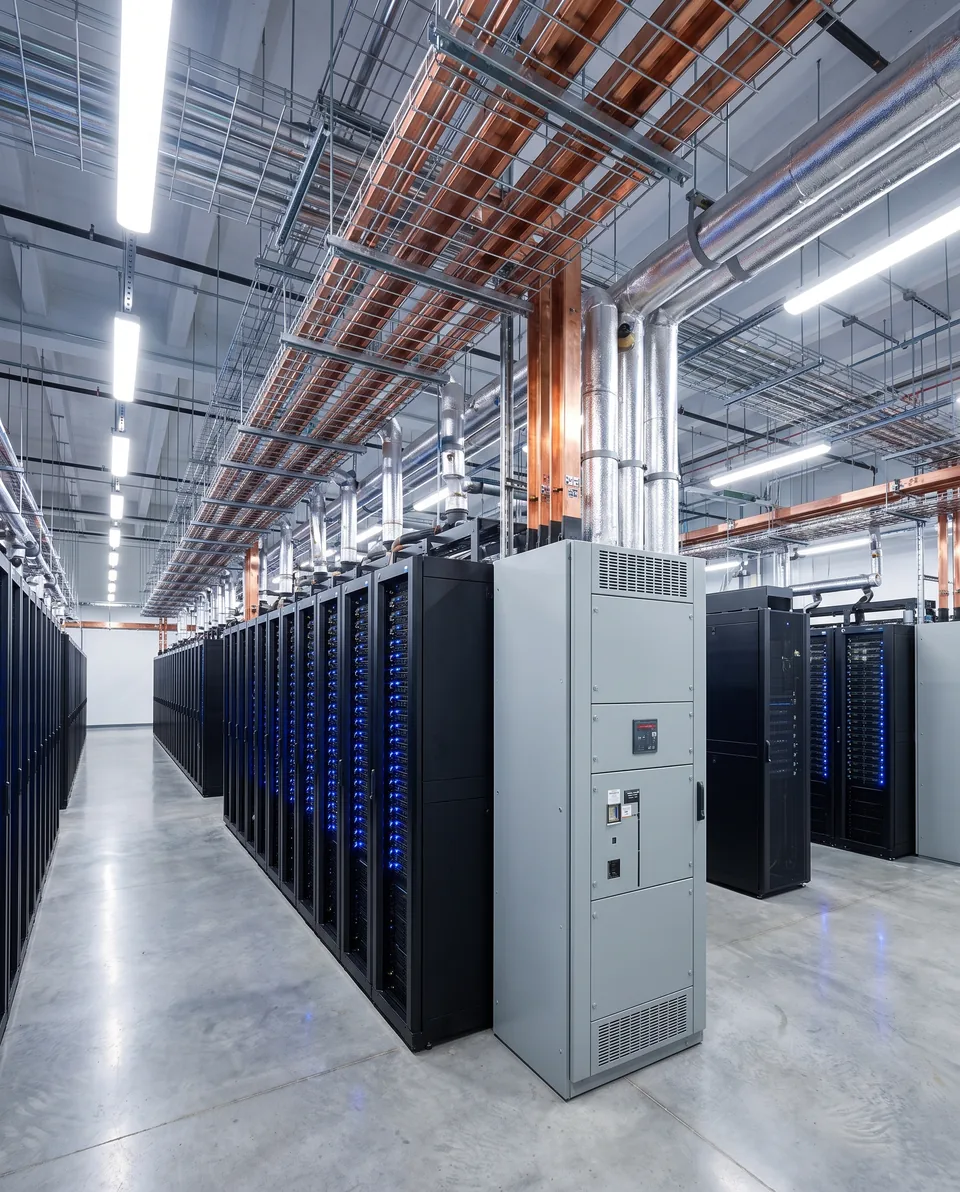
Seven layers, one build-out
Which stocks belong in an AI infrastructure index?
A new AI data center needs chips, servers to put them in, networking to connect them, switchgear and cooling to keep them running, a utility to supply the power, a contractor to build the substation, and an owner for the building. An AI infrastructure index is some mix of those seven layers.
1
Compute and memory
The GPUs, custom accelerators and memory chips inside every AI server. The layer most AI funds already overweight.
NVDA, AVGO, MU
2
Servers and storage
The companies that assemble the racks and sell the drives that hold training data.
DELL, SMCI, STX
3
Networking and optical
Switches, optical transceivers and connectors that tie thousands of GPUs into one cluster.
ANET, CIEN, APH
4
Electrical equipment and cooling
Switchgear, transformers, power distribution and liquid cooling. Every megawatt of compute needs it.
ETN, GEV, VRT
5
Power generation and utilities
The utilities and independent producers, nuclear included, signing supply deals with data center owners.
CEG, PEG, CCJ
6
Construction and engineering
The contractors that build substations, transmission lines and the data center shells.
PWR, MTZ, MYRG
7
Data center owners
REITs and operators that own the buildings and lease space and power to cloud companies.
EQIX, DLR, IRM
The tickers are examples taken from the funds' own holdings, not recommendations. The layers behave differently. Chips and memory swing with orders for AI servers. Electrical equipment and construction move with capital spending plans that run for years once a site is approved. Utilities are regulated and pay dividends, so they tend to fall less in a sell-off and rise less in a rally. Data center REITs behave partly like real estate, which means interest rates matter to them in a way they do not to an equipment maker.
That is the real argument for building your own. If your view is "the bottleneck is power, not chips", you can hold 40% in the power and grid layers and 10% in chips, which no single fund does exactly. If your view is the opposite, the AI stocks index builder covers the chip, cloud and software side of the same theme.
From a view on the build-out to a basket you can buy
How to build your own AI infrastructure index in four steps
1
Set the layer weights
Decide how much goes to power, grid equipment, chips, networking, construction and data center owners before you pick a single stock.
2
Fill each layer
Search the catalog of US-listed stocks and ETFs and add three to five names per layer. 20 to 35 in total is typical.
3
Backtest against the funds
Run it against the S&P 500 and the Nasdaq-100, and build a one-line index of AIPO or DTCR to put the fund on the same chart.
4
Track it, then buy it
Follow the index daily against its benchmark, export the weights, and place the basket at your own broker when you are ready.
A backtest is where the young funds fall short and your own basket does not. AIPO and TCAI have about a year of history. The stocks inside them, Eaton, Quanta, Vertiv, Constellation, Equinix, have a decade or more, so a basket of them can be run through 2020 and 2022, two very different years for utilities and REITs. Look at the maximum drawdown beside the S&P 500 before you look at the return. Backtests are hypothetical and past returns do not predict future ones; use them to compare designs, not to forecast. Weight drift matters here too, because the power names have run hard, so test a quarterly reset with the custom index rebalancing tool.
Three ways to own the AI build-out, compared honestly
Build your own AI infrastructure index vs an AI infrastructure ETF vs a basket broker
| AI infrastructure ETF | Fidelity Basket Portfolios | Indexes, then your broker | |
|---|---|---|---|
| Who sets the layer mix | The fund's index or manager | You | You, and you can test it first |
| Yearly cost | 0.39% to 0.75% of the balance | $4.99 a month flat | From $12 a month for the software, plus your broker's cost |
| History you can test | Since launch, often one year | None | As far back as your stocks go |
| Cell towers and foreign listings | Included in some funds | Only if you add them | Only if you add them |
| Per-stock tax losses | No | Yes, done by you | Yes, at your broker |
| Where it falls short | You take someone else's layer bet | No way to test a design before buying | You place and rebalance the trades |
The ETF wins when you want one ticker and no upkeep, and when one fund's mix already matches your view. POWR at 0.39% is the cheap way to own the US power layer alone. The build-your-own route wins once the balance passes roughly $8,000 to $12,000, the point where a flat $59.88 a year beats a 0.50% to 0.75% fee, and whenever your layer weights differ from every fund on the list. Owning the stocks also gives each position its own cost basis, so a losing utility can be sold for a tax loss while the rest of the basket stays put. Check the dates with the wash sale calculator before you buy a similar name back.
What Indexes does and does not do: it is index construction, backtesting and tracking software. It does not hold money, place trades or give investment advice. You design and test the AI infrastructure index here and hold it wherever you already invest.
AI infrastructure ETF and stock questions
What people ask before they buy the AI build-out
What is the best AI infrastructure ETF?
It depends on which layer you mean. AIPO (0.69%) is 80% power, grid and construction by rule. TCAI (0.65%) is actively managed across servers, cooling and power. RACK (0.50%) spreads across chips, networking and power. DTCR (0.50%) is mostly data center and cell tower REITs. POWR (0.39%) is the cheapest, and holds US power companies only.
What are AI infrastructure stocks?
They are the companies that supply the physical build-out behind AI: chip and memory makers, server and networking vendors, electrical equipment and cooling suppliers such as Eaton and Vertiv, utilities and power producers, the contractors that build substations, and the REITs that own data centers. Most AI infrastructure funds hold four or five of those layers at very different weights.
Is there a Vanguard AI infrastructure ETF?
No. Vanguard does not offer an AI infrastructure or data center ETF. Its closest funds are the Vanguard Information Technology ETF (VGT, 0.09%) for the chip and hardware side, the Vanguard Utilities ETF (VPU, 0.09%) for power producers, and the Vanguard Real Estate ETF (VNQ, 0.13%), which holds Equinix and Digital Realty among other REITs.
What are the best AI data center stocks?
The AI infrastructure funds agree on a short list more than on anything else. Eaton appears in AIPO, GRID, RACK and ZAP. Quanta Services is in AIPO, GRID, ZAP, TCAI and RACK. Vertiv, GE Vernova and Constellation Energy each appear in at least three. Equinix and Digital Realty lead the data center REIT funds. Those overlaps are a starting universe, not a recommendation.
What are AI power stocks?
AI power stocks are the utilities, power producers and grid equipment makers expected to supply data center electricity. In the funds, that means names such as Constellation Energy, Public Service Enterprise Group, Cameco, Bloom Energy, GE Vernova and Eaton. AIPO puts 65% of its index into power generation, grid equipment and utilities by rule.
Is it cheaper to build your own AI infrastructure index than to buy an ETF?
Above a certain balance, yes. Fidelity Basket Portfolios charges a flat $4.99 a month, $59.88 a year, with no expense ratio. That beats a 0.75% fund above about $8,000, a 0.69% fund above about $8,700, a 0.65% fund above about $9,200 and a 0.50% fund above about $12,000. Below those balances the ETF costs less.
How many stocks should an AI infrastructure index hold?
The funds hold 25 to 123. For a homemade index, 20 to 35 is practical: enough for three or four names in each layer you want, few enough to rebalance by hand. Decide the layer weights first, for example 30% power and grid, 25% chips and servers, 20% networking, 15% construction, 10% data center owners, then fill each layer.
Can I backtest an AI infrastructure ETF against my own basket?
Yes. In Indexes you build your basket, then build a second index holding only AIPO, TCAI or DTCR, and compare both against the S&P 500 or the Nasdaq-100 over the same dates. Funds launched in 2025 and 2026 have short histories, so your basket, built from older stocks, can be tested over far more years than the fund itself.
Sources
Expense ratios, holdings counts and top holdings from each issuer, read September 28 and 29, 2026: defianceetfs.com (AIPO), tortoisecapital.com daily holdings (TCAI), globalxetfs.com fund pages and holdings files (DTCR, ZAP), ftportfolios.com (GRID), wedbushfunds.com (IVEP) and VanEck's RACK page as captured on September 21. POWR and IVEP top holdings are from their most recent SEC Form N-PORT filings (June 30 and July 31), because the live pages could not be read. Weighting rules from each fund's summary prospectus (Form 497K) or registration statement on sec.gov. Segment splits: AIPO from its index rules, DTCR and ZAP from the issuers' sector breakdowns as of August 31, RACK summed from its September 18 holdings. Vanguard fund fees from vanguard.com. Fidelity Basket Portfolios pricing from fidelity.com. Expense ratios and holdings change, so confirm them on the fund page before you buy. Indexes is not affiliated with any fund issuer or broker named here. We make index construction and backtesting software: we do not manage money, place trades or give investment advice, and backtested results are hypothetical.
Build the AI infrastructure index your view calls for
Choose the layers and the weights, backtest the basket against the S&P 500 and the funds, and track it every day. Then buy it wherever you invest.
Keep reading